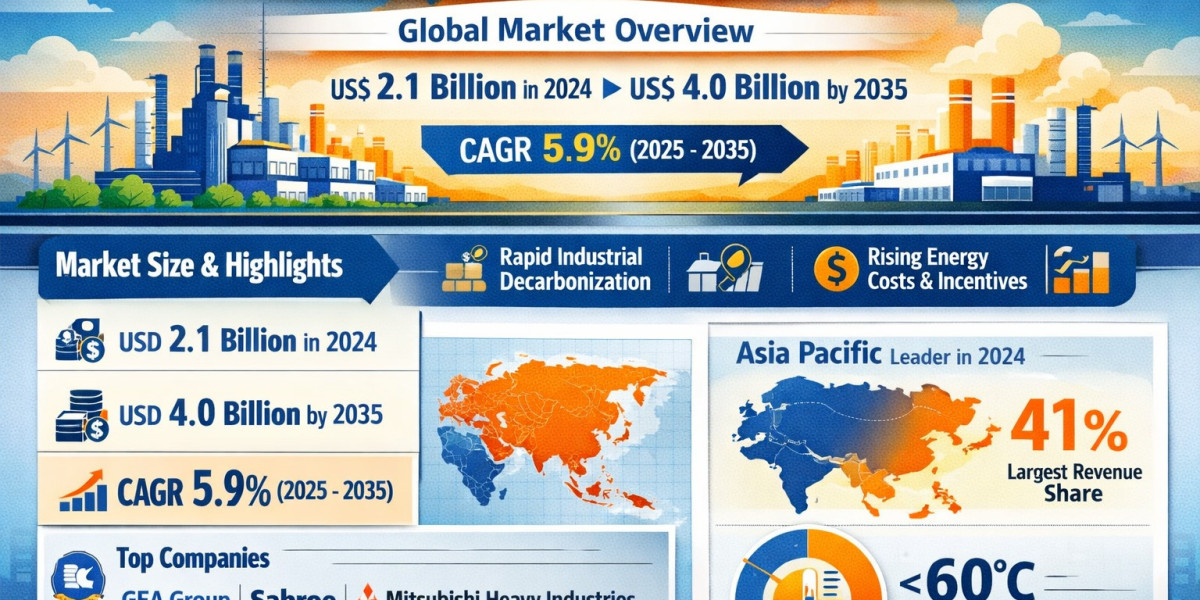

The global industrial heat pumps market is gaining strong momentum as manufacturers seek cost-effective, scalable pathways to decarbonize process heat. Valued at US$ 2.1 billion in 2024, the market is projected to reach US$ 4.0 billion by 2035, expanding at a CAGR of 5.9% from 2025 to 2035. Growth is primarily driven by industrial decarbonization mandates, rising fossil-fuel costs, and compelling efficiency-driven economics.
Market Size & Key Highlights
Market size (2024): US$ 2.1 Billion
Forecast (2035): US$ 4.0 Billion
CAGR (2025–2035): 5.9%
Key players: GEA Group, Sabroe, Mitsubishi Heavy Industries
Leading region: Asia Pacific (41% revenue share in 2024)
Top temperature segment: <60 °C, accounting for 38% of the market
Industrial heat pumps are rapidly shifting from niche efficiency solutions to core infrastructure for low-carbon industrial heating.
Analysts’ Viewpoint: Industrial Heat Pumps Move into the Core of Process Decarbonization
Analysts indicate that the industrial heat pumps market has entered a structural growth phase, shaped by climate policy, electrification strategies, and long-term energy-cost pressures. While Asia Pacific leads global deployment due to its vast manufacturing base and proactive electrification policies, Europe and North America are accelerating adoption under ambitious climate targets and financial incentives such as the EU Innovation Fund and the U.S. Inflation Reduction Act (IRA).
Technological progress—particularly in high-temperature systems using ammonia and CO₂ refrigerants—has expanded the application range well beyond traditional low-temperature use cases. Industries such as chemicals, food processing, pharmaceuticals, pulp & paper, and textiles can now substitute or hybridize fossil-fuel boilers with heat pumps. Market leaders including GEA, Mitsubishi Heavy Industries, and Everllence are leveraging these advances to deliver solutions that offer both strong ESG performance and compelling payback economics.
Global Industrial Heat Pumps Market Overview
Industrial heat pumps are electrified thermal systems that upgrade low-grade waste or ambient heat to usable process temperatures. Operating via mechanical vapor compression or thermally driven cycles, these systems can achieve 300–500% efficiency, making them three to five times more efficient than combustion-based heating.
Industrial heat pumps cover a wide temperature range—from below 60 °C for food processing and washing, to over 200 °C for chemicals, textiles, and pharmaceuticals. Their flexibility enables applications such as process pre-heating, drying, evaporation, pasteurization, cleaning-in-place (CIP), steam pre-generation, and waste-heat upgrading.
As electricity increasingly comes from renewable sources, industrial heat pumps allow manufacturers to cut emissions, stabilize energy costs, and comply with tightening regulations—all while improving operational efficiency.
Decarbonization Mandates Drive Rapid Adoption
Rapid industrial decarbonization is one of the most powerful drivers of market growth. Policies such as the EU Fit for 55 package, which mandates a 55% emissions reduction by 2030, and rising carbon prices—EUR 80–90 per ton in Europe—are sharply increasing the operating costs of fossil-fuel boilers.
Industries including chemicals, food & beverage, and pulp & paper are under mounting pressure to phase out natural gas and fuel oil. By integrating industrial heat pumps, facilities can reduce CO₂ emissions by 30–60%, depending on process integration and electricity mix.
Countries such as Germany and Japan offer subsidies covering 40–50% of capital expenditure, accelerating adoption. Large food and beverage manufacturers have already deployed heat pumps to recover waste heat, cutting thousands of tons of CO₂ annually while achieving strong economic returns. As industries align with 2030 and 2050 net-zero targets, heat pumps are emerging as a strategic compliance technology.
Energy Cost Volatility Strengthens the Business Case
Rising and volatile energy prices are further accelerating market growth. While fossil-fuel prices remain uncertain, expanding renewable power capacity is improving the long-term cost competitiveness of electricity.
Industrial heat pumps can deliver 300–500% efficiency, translating into substantial energy-cost reductions—particularly for processes operating between 60 °C and 150 °C. For example, a medium-scale food processing facility replacing a gas boiler with a 1 MW industrial heat pump can reduce annual energy expenses by up to US$ 350,000, depending on local tariffs and heat recovery potential.
These economics are making heat pumps increasingly attractive even without subsidies, especially in regions with high gas prices or carbon costs.
<60 °C Segment Leads Commercial Adoption
The <60 °C temperature range is the largest and most mature segment, accounting for around 38–40% of global installations. It is widely used in food & beverage processing, textiles, district heating, washing, and cleaning applications.
Low-temperature heat pumps deliver COP values between 3.5 and 6, enabling thermal energy cost reductions of up to 60% versus gas boilers. Many facilities already generate suitable waste heat from chillers, compressors, and refrigeration systems, making integration relatively simple.
Proven solutions from GEA, Johnson Controls, and Mitsubishi Heavy Industries have reduced technical risk, positioning <60 °C systems as a low-risk, high-return entry point for industrial decarbonization.
Regional Insights: Asia Pacific Leads, Europe and North America Catch Up
Asia Pacific dominates the industrial heat pumps market, accounting for approximately 41% of global demand. Rapid industrial growth and strict energy-efficiency policies in China, Japan, and South Korea are driving widespread deployment. Japan alone has installed over 3,000 high-temperature industrial heat pumps since 2022, particularly in chemicals, electronics, and district energy.
Europe holds around 28% market share, driven by the EU Green Deal and aggressive decarbonization targets. Germany added more than 800 MW of industrial and district heat-pump capacity in 2023 alone.
North America, with an estimated 18% share, is gaining momentum under IRA incentives, particularly in food processing and pulp & paper. Over the past two years, industrial facilities have added around 200 MW of new heat-pump capacity.
Competitive Landscape and Key Developments
Leading players include GEA, Mitsubishi Heavy Industries, Daikin Applied Europe, Johnson Controls, Siemens Energy, Sabroe, Atlas Copco, Carrier, Everllence, Bosch Industrial, and others.
Recent developments highlight rapid technological scaling:
GEA (2025): Deployed high-temperature heat pumps for sugar processing, upgrading waste heat to 135–160 °C and replacing fossil-fuel boilers.
Mitsubishi Heavy Industries (2025): Launched compact, high-efficiency modules reducing installation footprint by ~28%, targeting retrofit markets.
Everllence (MAN Energy Solutions, 2024): Commissioned the world’s largest CO₂-based seawater heat pump in Denmark (70 MW), supplying climate-neutral district heat and cutting 120,000 tons of CO₂ annually.
Outlook to 2035
By 2035, industrial heat pumps will be central to industrial electrification strategies worldwide. Supported by policy incentives, rising carbon costs, and improving high-temperature performance, heat pumps are transitioning from efficiency upgrades to mission-critical infrastructure. As industries prioritize cost stability, regulatory compliance, and deep emissions cuts, industrial heat pumps will play a defining role in the global shift toward sustainable, low-carbon manufacturing.