
The digital asset ecosystem is undergoing a rapid transformation, with crypto wallets becoming a foundational infrastructure layer for managing, storing, and transacting cryptocurrencies. As adoption of digital assets accelerates globally, the market is moving beyond retail usage into institutional-grade custody, payment systems, and enterprise blockchain applications.
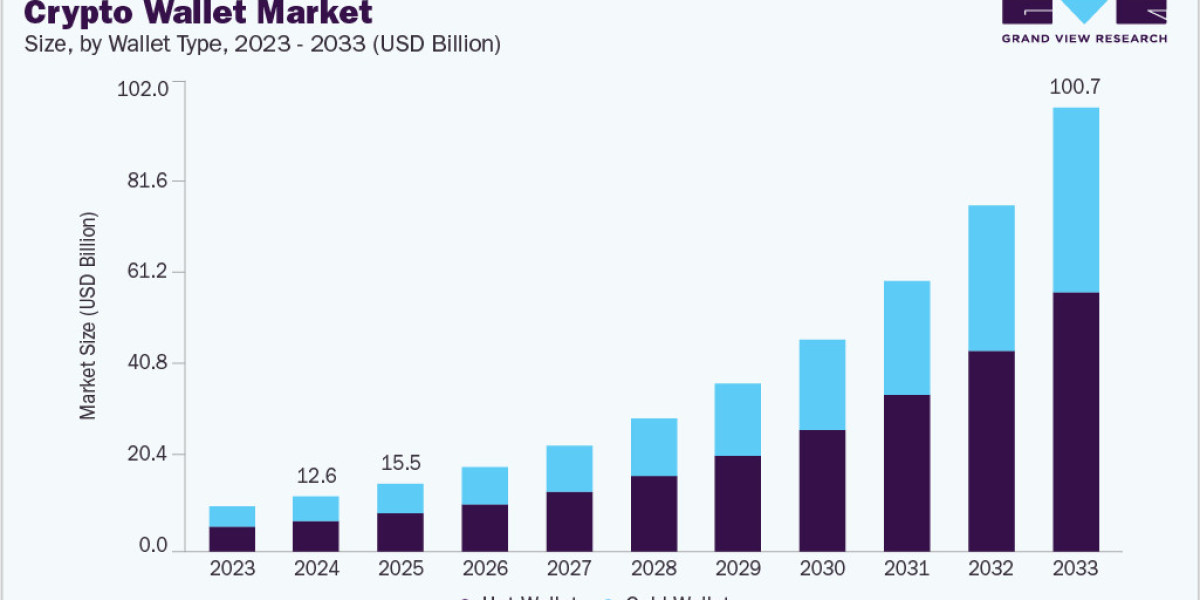
The global crypto wallet market size is expected to reach USD 100.77 billion by 2033, growing at a CAGR of 26.3% from 2025 to 2033. A major driver behind this expansion is the increasing recognition of cryptocurrencies as a legitimate asset class, supported by growing participation from financial institutions, payment processors, and regulated custodians. This shift is redefining how crypto wallets function, evolving them from simple storage tools into secure digital asset management platforms.
How crypto wallets work in a rapidly evolving ecosystem
Understanding how crypto wallets work is essential to evaluating their role in the broader digital finance infrastructure. A crypto wallet does not actually store cryptocurrencies in a physical sense. Instead, it manages cryptographic keys that enable users to access and authorize blockchain transactions.
Each wallet contains two core components: a public key, which acts as an address for receiving assets, and a private key, which is used to sign transactions and prove ownership. When a transaction is initiated, the wallet uses cryptographic signatures to validate authenticity before broadcasting it to the blockchain network.
Recent developments in wallet technology have significantly improved usability and security. Wallet architectures are now broadly categorized into hot wallets, which remain connected to the internet for quick access, and cold wallets, which operate offline to minimize exposure to cyber threats. Hybrid models combining both approaches are also gaining traction, especially among institutional investors managing large asset portfolios.
However, evolving threat landscapes are reshaping design priorities. Incidents involving malicious browser extensions, phishing attacks targeting seed phrases, and mobile malware designed to extract wallet credentials have highlighted that security risks often originate at the user interface and device level rather than the blockchain itself. As a result, wallet providers are increasingly focusing on multi-layer authentication, hardware isolation, and transaction-level verification mechanisms.
Market expansion and competitive dynamics shaping the crypto wallet industry
The crypto wallet ecosystem is highly competitive, with companies focusing on custody solutions, user experience optimization, multi-chain compatibility, and institutional security frameworks. As transaction volumes increase and asset tokenization expands, wallet providers are evolving into full-scale digital asset infrastructure companies.
The growing demand for secure storage and seamless transaction management has strengthened the position of both centralized platforms and decentralized wallet providers. At the same time, institutional adoption is driving demand for regulated custody solutions with insurance coverage, compliance tools, and advanced key management systems.
Key companies in the crypto wallet market include:
- Coinbase
- BitGo Holdings, Inc.
- Binance
- BitPay
- Trezor
- Ledger SAS
- Exodus Movement, Inc.
- Zengo Ltd.
- Crypto.com
- Blockchain.com
These organizations collectively shape industry standards across hardware wallets, exchange-based wallets, multi-signature custody platforms, and mobile-first wallet applications. Hardware wallet providers such as Ledger SAS and Trezor focus on cold storage security, while platforms like Coinbase, Binance, and Crypto.com integrate wallets into broader trading and financial ecosystems. Institutional-grade custody solutions offered by firms such as BitGo Holdings, Inc. are playing a crucial role in enabling large-scale asset management and regulatory compliance.
Future outlook of crypto wallet infrastructure and security evolution
The future of crypto wallet development is being shaped by three dominant trends: enhanced security architecture, institutional-grade custody solutions, and seamless multi-chain interoperability. As digital asset portfolios become more diversified, wallets are evolving to support cross-chain transactions, decentralized finance integrations, and tokenized real-world assets.
At the same time, security innovation remains central to market growth. The increasing sophistication of cyber threats is pushing the industry toward hardware-based isolation, biometric authentication, and smart contract-based transaction validation. These advancements aim to reduce reliance on vulnerable seed phrases and minimize human error in asset management.
In parallel, regulatory clarity across major markets is encouraging institutional participation, further accelerating demand for compliant wallet infrastructure. As a result, crypto wallets are no longer viewed as optional tools but as critical components of the global digital financial system.
Overall, the crypto wallet market is transitioning from a retail-driven utility into a complex, security-intensive infrastructure layer. With strong growth projections, expanding use cases, and continuous innovation, the sector is positioned to remain a core pillar of the digital economy through 2033 and beyond.