
Industrial infrastructure continues to expand across sectors such as water management, energy production, chemicals, and manufacturing. As these systems become larger and more complex, efficient flow control has become essential to ensure operational reliability and safety. Butterfly valves have emerged as one of the most widely adopted solutions for regulating and isolating fluid flow because of their compact design, cost efficiency, and ability to handle large volumes of liquids and gases.
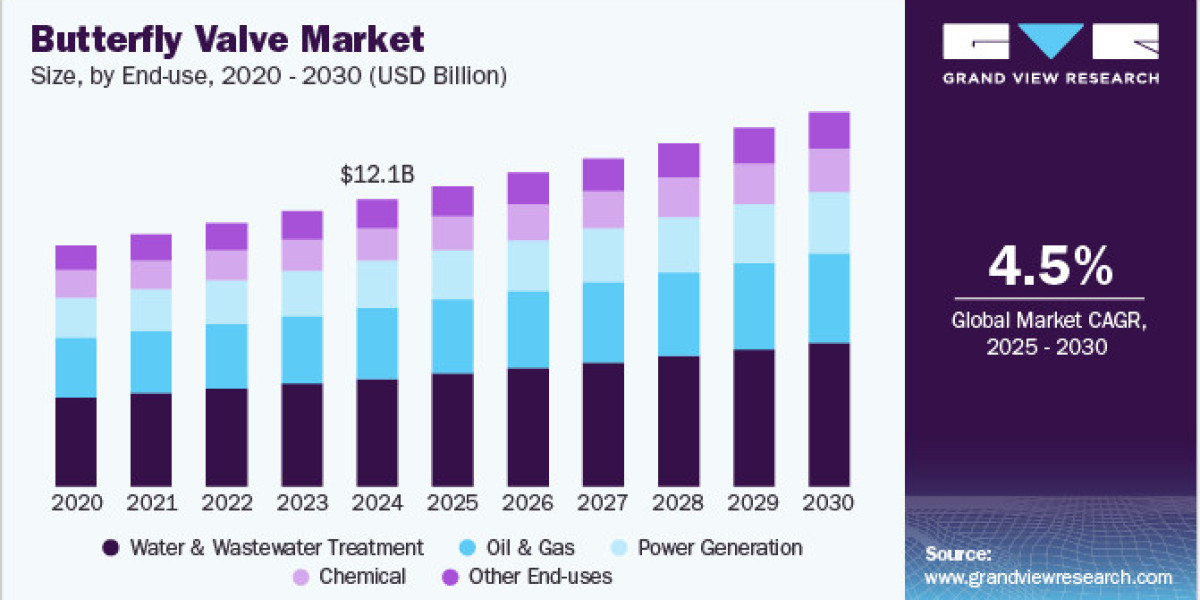
The increasing demand for reliable flow control solutions across pipeline networks, industrial processing facilities, and municipal infrastructure is influencing the direction of the global butterfly valve industry. According to industry estimates, the global butterfly valve market size was estimated at USD 12.12 billion in 2024 and is projected to reach USD 15.78 billion by 2030, growing at a CAGR of 4.5% from 2025 to 2030. This expansion is largely driven by the robust demand from the oil and gas sector, where butterfly valves are extensively used in upstream, midstream, and downstream operations for isolating and regulating flow.
Beyond the energy sector, butterfly valves are also playing an increasingly critical role in modern water management systems. Rapid urbanization and growing pressure on water resources are pushing governments and infrastructure operators to upgrade water distribution networks and treatment plants. In these facilities, a butterfly valve for water treatment is widely used because it allows efficient flow regulation within large-diameter pipelines while maintaining relatively low pressure drop. Its simple quarter-turn operation and lightweight design make it ideal for large-scale municipal installations where reliability and quick maintenance are essential.
Smart Automation and Advanced Materials Transforming Valve Design
Technological innovation is reshaping the way valves are designed, monitored, and maintained. Many industrial facilities are moving toward automated systems that allow operators to control flow remotely while monitoring system performance in real time. Electrically actuated and pneumatically controlled butterfly valves are increasingly being integrated into automated process environments, enabling precise control over pressure and flow conditions.
Smart monitoring features are also becoming more common. Sensors embedded within valve assemblies can track parameters such as temperature, vibration, and flow rate. This data can then be integrated into digital monitoring platforms, helping engineers detect potential performance issues before they lead to operational disruptions. For large infrastructure installations such as chemical plants, power generation facilities, and water distribution networks, these predictive capabilities are becoming an essential part of maintenance strategies.
Material science is another area where innovation is driving improvements. Manufacturers are increasingly adopting corrosion-resistant alloys, high-performance polymers, and specialized linings to extend valve lifespan and improve performance in aggressive environments. These materials allow butterfly valves to operate reliably in applications involving chemicals, high temperatures, or abrasive fluids. As industries seek longer service life and lower maintenance costs, these engineering enhancements are becoming key differentiators for any butterfly valve manufacturer competing in global industrial markets.
Water Infrastructure and Energy Systems Expanding Deployment
Water infrastructure modernization is one of the strongest drivers for butterfly valve adoption. Municipal authorities around the world are upgrading aging pipelines, expanding wastewater treatment facilities, and investing in desalination plants to meet growing water demand. In these systems, large-diameter valves must handle significant fluid volumes while maintaining efficient sealing and flow regulation. A butterfly valve for water treatment is particularly suited to these applications because it combines compact installation requirements with reliable shut-off capability.
Energy infrastructure is also contributing to rising valve demand. Oil and gas pipelines, refineries, and petrochemical processing units require valves capable of controlling high-pressure fluid flow while ensuring operational safety. Butterfly valves are widely used across these operations due to their ability to provide quick shut-off and minimal leakage when properly engineered. As energy infrastructure expands to support global fuel demand and industrial activity, the role of these valves within fluid control systems continues to grow.
Within this evolving landscape, several major engineering firms are shaping innovation and product development. Key butterfly valve companies include Alfa Laval Corporate AB, Curtiss-Wright Corporation, Flowserve Corporation, Emerson Electric Co., Pentair PLC, Weir Group PLC, AVK Group A/S, Crane Company, Schlumberger Limited, Velan Inc., and KSB SE & Co. KGaA. These organizations collectively influence product development trends through advanced manufacturing technologies, global supply networks, and investments in automation-ready valve systems.
As industries continue to modernize infrastructure and integrate digital technologies, the role of butterfly valves is expected to expand further. From large water distribution networks to complex energy pipelines, these valves remain a fundamental component of fluid control systems. For every butterfly valve manufacturer, the ability to deliver durable materials, automation compatibility, and application-specific engineering will define competitiveness in an industry where reliability and precision remain paramount.